
Typical British Houses and Italian Houses
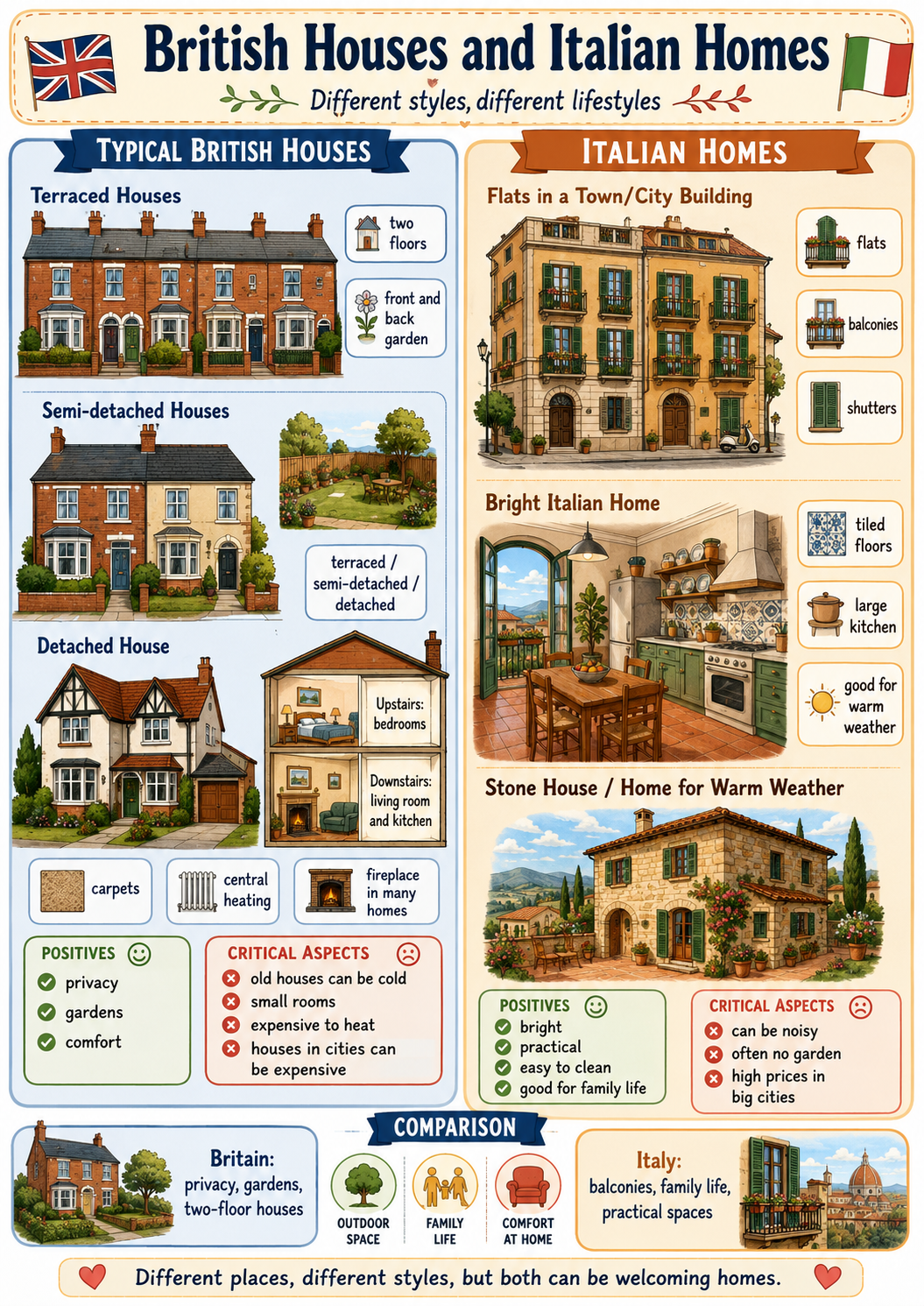
British houses are often different from Italian houses. In Britain, many people live in houses with two floors. These houses usually have a living room, a kitchen, bedrooms upstairs and one or two bathrooms. Many British houses also have a small front garden and a back garden. The back garden is often used for relaxing, gardening, or having a barbecue when the weather is good — which, in Britain, is sometimes a small miracle.
One very common type of house in Britain is the terraced house. A terraced house is joined to other houses on both sides. These houses are often found in towns and cities. Another common type is the semi-detached house, which is joined to one other house. There are also detached houses, which stand alone and are usually bigger and more expensive.
In many British homes, the living room is an important place. Families watch TV, talk, read or relax there. The kitchen can be small or large, and in some houses it is connected to the dining room. Bedrooms are usually upstairs, while the living room and kitchen are downstairs.
A typical British house often has carpets, especially in bedrooms and living rooms. In Italy, floors are more often made of tiles, marble or wood. British houses also often have central heating, because the weather can be cold and rainy. Fireplaces are traditional in some older homes, but today many people use modern heating systems.
In Italy, many people live in flats, especially in towns and cities. Italian homes can have balconies, tiled floors, large kitchens and shutters on the windows. In some areas, houses are made of stone or have thick walls to keep them cool in summer. Italian homes are often designed for family life, and the kitchen is usually a very important room.
There are some positive aspects of British houses. Gardens give people outdoor space, and two-floor houses can feel comfortable and private. However, there are also some critical aspects. Some British houses are old and can be expensive to heat. Rooms can be small, and carpets may be difficult to clean. In cities, houses can also be very expensive.
Italian homes also have positive aspects. They are often practical, bright and good for warm weather. Balconies are useful, and tiled floors are easy to clean. However, flats can be noisy because many families live in the same building. Some homes may not have a garden, and in big cities prices can be very high.
Both British and Italian homes show the culture and lifestyle of the country. British houses often give importance to privacy, gardens and comfort. Italian homes often give importance to family life, light and practical spaces. They are different, but both can be welcoming places to live.
True or False
Put an X in the correct box.
- Many British houses have two floors.
☐ True ☐ False - A terraced house is joined to other houses.
☐ True ☐ False - British houses never have gardens.
☐ True ☐ False - In Italy, many people live in flats, especially in towns and cities.
☐ True ☐ False - Both British and Italian homes can have positive and negative aspects.
☐ True ☐ False
Open Questions
Answer in simple English.
- What rooms can you usually find in a British house?
- What is a terraced house?
- What is the difference between a semi-detached house and a detached house?
- Why do British houses often have central heating?
- What are some typical characteristics of Italian homes?
- Which type of home do you prefer, a British house or an Italian home? Why?